

Mention Microsoft in a casual conversation and you’re likely to get a mixed reaction. Some people appreciate the company’s software, cloud services, and productivity tools, while others immediately groan at the thought of Windows updates, spreadsheets, or corporate email. Interestingly, this negativity is often less about Microsoft’s technology itself and more about what Microsoft represents in people’s minds. For millions of users, Microsoft is closely associated with work, school, deadlines, and obligations. Unfortunately for Microsoft, people generally don’t have warm feelings toward the activities they are required to do.
For decades, Microsoft software has dominated workplaces and educational institutions. Employees spend their days inside Outlook, Teams, Word, Excel, and PowerPoint. Students write reports in Word, create presentations in PowerPoint, and complete assignments on Windows laptops. When people think of Microsoft, they often think of meetings, homework, performance reviews, budget spreadsheets, and email inboxes overflowing with tasks. Psychologists call this associative learning. We naturally connect a tool with the emotions we experience while using it. If someone spends eight stressful hours a day inside Microsoft applications, it should not be surprising that they develop a less-than-enthusiastic attitude toward the brand itself.
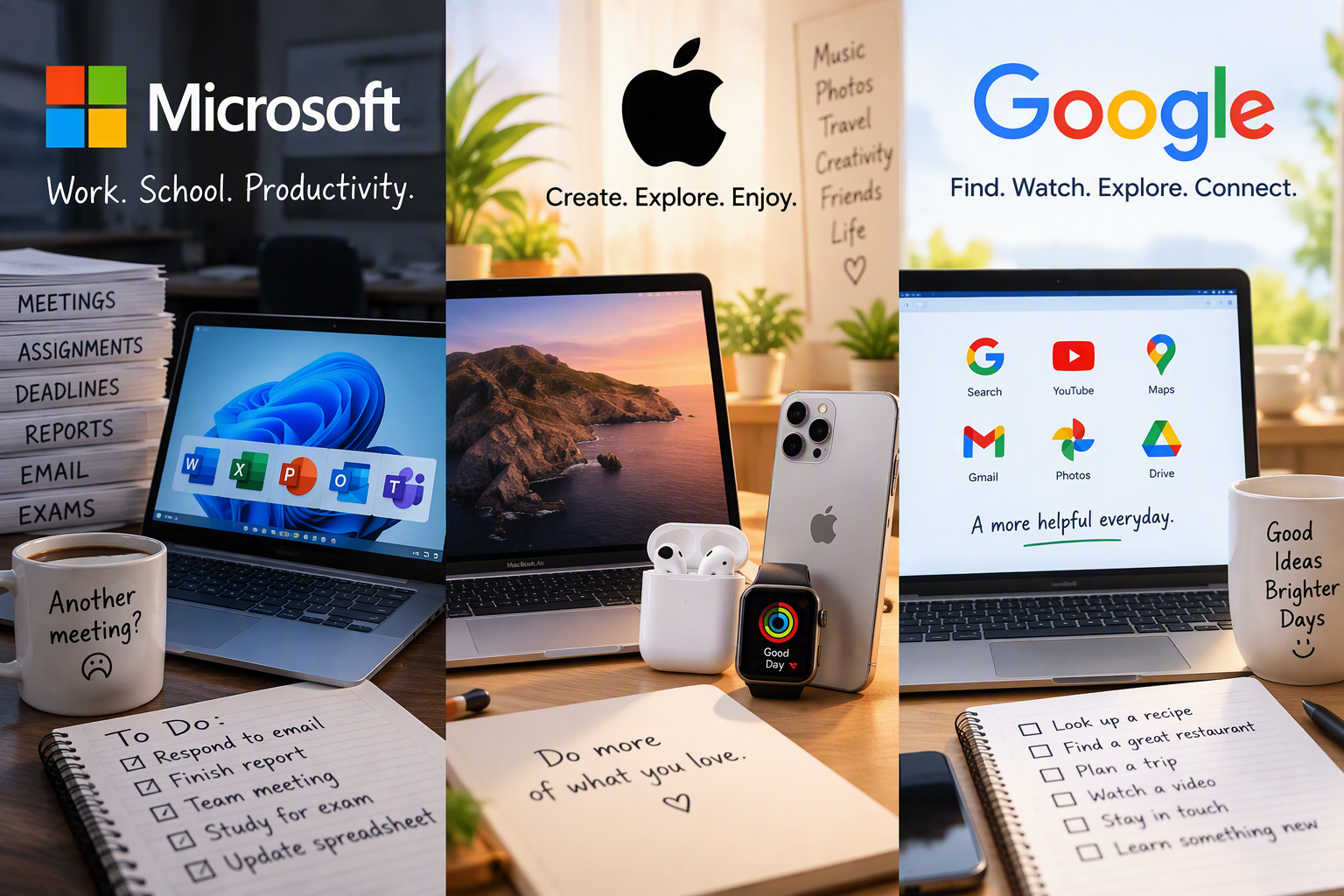
Apple, by contrast, enjoys a very different relationship with consumers. Most people purchase iPhones, iPads, AirPods, or MacBooks for personal use rather than because an employer or school requires them. Apple products are frequently associated with entertainment, creativity, communication, photography, music, travel, and leisure. Consumers eagerly line up to buy the latest iPhone not because they have to, but because they want to. That distinction matters. Voluntary experiences generally create more positive emotional connections than mandatory ones. As a result, Apple is often perceived as a lifestyle brand, while Microsoft is perceived as a utility company.
Google occupies an interesting middle ground. While Google Workspace is common in business and education, many people primarily interact with Google through consumer-focused services such as Gemini, Search, Maps, YouTube, Photos, and Gmail. These products help users find information, navigate to destinations, watch videos, and stay connected with friends and family. The experience often feels helpful, convenient, and free. When someone enjoys watching YouTube videos or uses Google Maps to find a great restaurant, those positive experiences contribute to favorable feelings toward the Google brand, even if they occasionally grumble about online advertising or privacy concerns.
In reality, Microsoft’s challenge may be one of perception rather than technology. The same company that powers corporate spreadsheets also creates Xbox gaming platforms, innovative AI tools, Surface devices, and cloud services that run much of the modern internet. Yet for many people, Microsoft’s identity remains tied to work and school. Apple represents personal enjoyment, and Google often represents convenience and discovery. Until people begin associating Microsoft with more of the things they love and fewer of the things they are required to do, the company may continue to face an image problem rooted not in its products, but in human psychology itself.